Cost-Benefit Analysis of Investing in Dental 3D Printing Technology
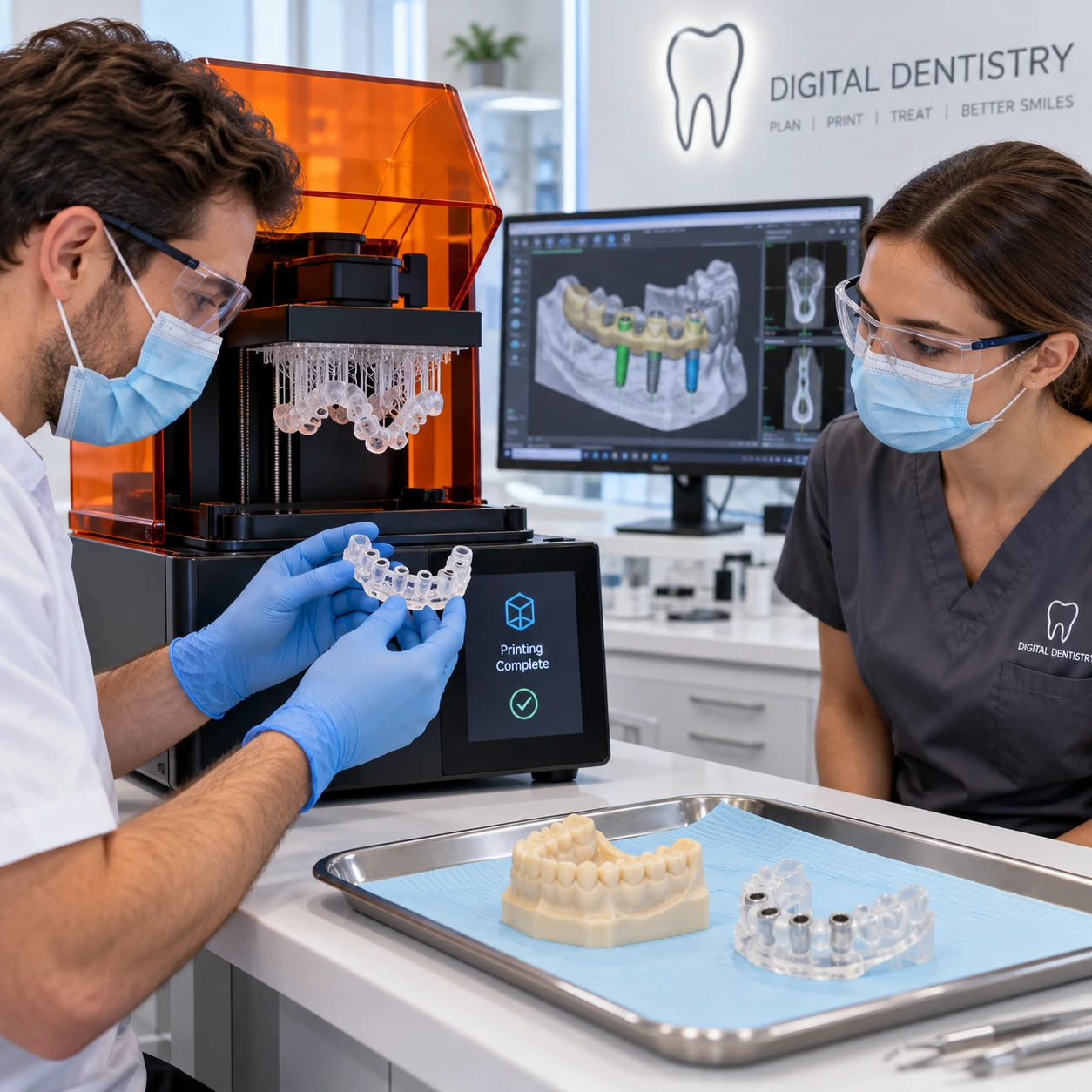
A dental 3D printer can bring parts of digital dentistry into a practice or dental laboratory, but owning one does not automatically reduce costs. The financial case depends on which items you produce, how often you need them, and the full cost of running the equipment.
A useful analysis compares in-house production with the current alternative, including outsourced production, staff time, turnaround, and quality-control needs. The right choice may be purchasing a printer, continuing to outsource, or using a mix of both.
What Does Dental 3D Printing Add to a Digital Workflow?
Dental 3D printing turns digital designs into physical dental models and devices, adding an on-demand production step to a digital workflow. It can support practices and labs that already capture or receive digital scans and have a suitable design and production process.
Common applications include dental models, surgical guides, splints, custom trays, and certain provisional or other patient-specific items. Which applications are appropriate depends on the printer, validated material, design software, and the product’s intended use. A printer is one part of the chain: scanning, case planning, design, printing, post-processing, and clinical or laboratory checks all matter.
For a practice, printing may support treatment planning or selected chairside and lab tasks. A dental laboratory may use it to produce models or other components as part of a broader production workflow. The potential value comes from a better fit between digital case flow and production needs, rather than from the printer alone.
The Upfront and Ongoing Costs
The cost of dental 3D printing includes initial equipment cost and the continuing expense of materials, software, staff time, maintenance, and quality controls. A realistic budget accounts for the complete production process, not just the printer’s purchase price.
Build a cost inventory before comparing vendors or calculating ROI:
- Equipment: The dental 3D printer, required washing and curing equipment, accessories, and any necessary workspace changes.
- Materials and consumables: Printer-compatible resins, build-platform or vat components, cleaning supplies, protective equipment, and items discarded during setup or failed prints.
- Software: Design tools, printer preparation software, subscriptions, updates, and any integration fees. Check whether the software supports your intended applications and file workflow.
- Training and staff time: Initial onboarding and the time needed to prepare files, handle materials, post-process parts, inspect output, and manage records.
- Maintenance and calibration: Routine cleaning, calibration, replacement parts, service plans, and downtime when equipment needs attention.
Also include the cost of validation and quality procedures suitable for the products you plan to make. Requirements differ by material and intended use, so confirm them with the manufacturer and relevant professional or regulatory guidance. A lower purchase price may be offset by higher consumable costs, limited application support, or a workflow that takes more staff time.
Potential Benefits for Practices and Labs
In-house dental 3D printing can give a practice or lab more control over production timing, workflow, and selected customization. These benefits are valuable only when the organization can use the printer reliably and keep it busy enough to justify its costs.
Printing locally may shorten the wait for some items, reduce dependence on an external production queue, and make it easier to coordinate design changes with the team. It can also give a dental laboratory more direct control over scheduling and production batches. For a practice, the value may include easier access to models or guides for suitable cases, subject to the printer system’s validated capabilities.
Customization is another potential advantage: a digital design can be adjusted to a case before production, and a replacement part may be easier to reproduce when the source file and process are retained. Still, digital files do not remove the need for accurate scans, sound design, material selection, and inspection. A failed print or rework can erase time savings, while a printer that sits idle adds ownership costs without improving workflow efficiency.
In-House Printing vs. Outsourcing
In-house printing exchanges an external per-item or per-case fee for equipment ownership and operational responsibility. Outsourcing usually limits fixed investment, while printing internally can offer more production control when case volume and workflow support it.
- In-house production: Offers direct control over scheduling and production, but requires equipment, materials, trained staff, maintenance, and capacity planning.
- Outsourced production: Avoids printer ownership and some day-to-day technical work, but may involve per-case charges, shipping, external lead times, and less control over production scheduling.
- Hybrid approach: Keeps frequent or time-sensitive suitable work in-house while outsourcing low-volume, specialized, or overflow cases.
Compare like with like. An outsourced quote may bundle design, production, finishing, and delivery; your in-house estimate should include each equivalent step. If staff must spend substantial time learning software or resolving print issues, that labor belongs in the comparison. Outsourcing can be the more economical choice for occasional cases, while high and predictable volume may strengthen the argument for internal capacity.
How to Assess ROI for Your Organization
Assess dental 3D printing ROI by comparing the annual cost of owning and operating the system with the costs it can realistically replace. The result depends most on eligible case volume, current outsourcing spend, printer utilization, and total ownership costs.
Use a simple framework:
- Define the work: List the specific products you would print and confirm they are appropriate for your system, materials, and workflow.
- Measure current spending: Review invoices for outsourced production, shipping, and related fees over a representative period. Separate costs that printing could replace from services you would still need.
- Estimate usable volume: Count likely cases, not every theoretical opportunity. Account for seasonality, staff capacity, failed prints, and work that will remain outsourced.
- Calculate full in-house cost: Include equipment and software costs over a chosen planning period, materials, consumables, labor, maintenance, training, and downtime.
- Compare scenarios: Model conservative, expected, and higher-volume use. Include a hybrid option and test how sensitive the result is to utilization or staff time.
A basic calculation is: net annual benefit = avoidable outsourced costs − annual in-house operating and ownership costs. If the result is positive, it suggests potential savings under those assumptions, not a guaranteed return. Add any operational benefits, such as faster access to a suitable item, separately rather than assigning them an unsupported dollar value.
For example, a lab with steady demand for a small set of printable items may be able to plan utilization and staff responsibilities more accurately than a practice that prints only occasionally. The lab should still verify that the relevant outsourced work is genuinely replaceable and account for reprints, maintenance, and the time required to manage production.
Key Questions Before Investing
Before investing in dental 3D printing technology, confirm that the team has the space, skills, materials, support, and workload to operate it consistently. A practical readiness check can reveal costs and bottlenecks that a printer quote will not show.
- Space and safety: Is there suitable room for the printer, post-processing equipment, materials, and safe handling procedures?
- Team readiness: Who will prepare files, operate the printer, finish parts, inspect output, and troubleshoot? Is protected training time available?
- Material and application fit: Do the system’s supported materials and validated workflows cover the items you intend to make?
- Service and support: What are the warranty terms, service response, replacement-part availability, and expected process during downtime?
- Expected workload: How many suitable cases are likely each month, and can they be grouped or scheduled to make production practical?
Ask vendors for a workflow demonstration using representative cases, a complete list of recurring costs, and clear details about training and service. Avoid basing the decision on the printer’s maximum capacity; usable output depends on preparation, post-processing, inspection, staffing, and demand.
Frequently Asked Questions
These answers summarize the main financial considerations: count every ownership cost, compare realistic case volume with avoidable outsourcing spend, and include staff time and operational risk in the decision.
What costs should be included in a dental 3D printing investment?
Include the printer and post-processing equipment, software, materials, consumables, training, staff labor, maintenance, calibration, service, and downtime. Include workspace or workflow changes if they are needed.
When does in-house printing make financial sense?
It may make sense when the organization has recurring, suitable cases; can maintain steady printer utilization; and can produce them internally for less than the avoidable cost of outsourcing. Test the calculation with conservative volume assumptions.
How does in-house printing compare with outsourcing?
In-house printing offers more direct control but adds fixed costs and operational duties. Outsourcing avoids equipment ownership and may suit low or irregular volume, though per-case fees and external turnaround remain part of the cost.
What factors can delay or reduce ROI?
Low utilization, staff learning time, failed prints, rework, unexpected maintenance, material costs, and work that still needs to be outsourced can all reduce returns. A mismatch between the printer’s capabilities and the organization’s actual cases can make the investment difficult to justify.
Dental 3D printing is most compelling when it solves a clearly identified production problem and fits an established digital workflow. Compare total costs and realistic demand before buying; for some practices and labs, outsourcing or a hybrid model will remain the better financial choice.